No Scale Coffee Brewing: Tablespoons to Grams Guide
No kitchen scale? You can still brew consistently. Use reliable tablespoon-to-grams ranges, dial in a simple coffee-to-water ratio, and avoid the common scoop mistakes that make one cup great and the next one weak.
Brewing great coffee without a scale can feel like you are flying blind, especially when a tablespoon of grounds can mean different things in different kitchens. The good news is that no scale does not have to mean random results. In this guide, you will learn why tablespoon measurements vary, how to convert tablespoons to grams with dependable ranges, and how to lock in a repeatable coffee-to-water ratio using a simple routine. Expect more consistency, less guesswork, and better cups day after day.
Tablespoon to grams coffee conversion you can trust
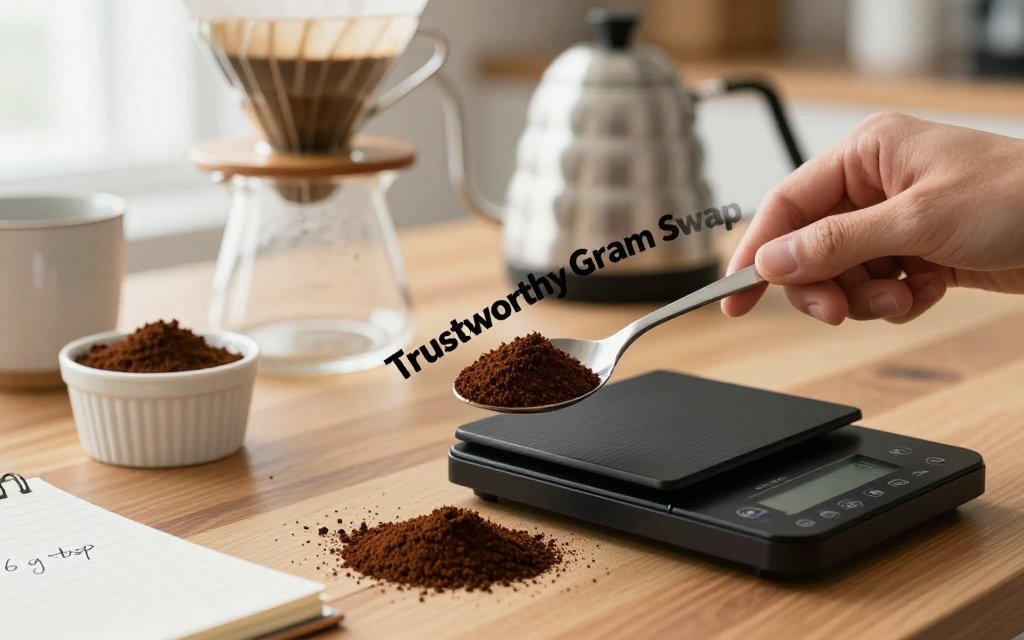
If you are trying to brew coffee by weight but only have a tablespoon, the goal is not perfection, it is repeatable “close enough” that tastes good. A tablespoon measures volume (about 15 mL), but coffee is a lightweight, irregular ingredient that can trap a lot of air. That is why two people can scoop “1 tablespoon” and end up with noticeably different brews, especially if one person levels the spoon and the other piles it high.
Here is a practical way to think about it: grams help you keep your coffee-to-water ratio steady, tablespoons help you move fast. Once you pick a baseline conversion for your kitchen, you can move between brewing styles with less guesswork. For example, many drip recipes sit around a 1:15 to 1:18 coffee-to-water ratio by weight. One well-known reference point is the “2 tablespoons per 6 oz water” guideline that also corresponds to about 55 g per liter, noted in a coffee ratio recommendation. That ratio math becomes easy once you have a tablespoon-to-grams estimate you trust.
Your quick answer: tablespoons of coffee in grams
Your quotable range is this: 1 level tablespoon of coffee grounds is usually about 5 to 7 grams. The main reason for the spread is density. Fine grinds settle into the spoon with fewer air pockets, so a level tablespoon of fine coffee tends to weigh more than a level tablespoon of coarse grounds. Roast level also nudges the number. Dark roasts are generally a bit less dense (beans expand more during roasting), so they can weigh slightly less per tablespoon than a light roast ground to the same size.
If you need a simple baseline that works across most home setups, start with 6 g per level tablespoon for planning, then adjust by taste. That baseline makes quick conversions easy: 2 level tablespoons is about 12 g, 3 tablespoons is about 18 g, and 4 tablespoons is about 24 g. For ounces, use 1 oz = 28.35 g. So 6 g is about 0.21 oz, 12 g is about 0.42 oz, and 24 g is about 0.85 oz. Example: for a 12 fl oz mug, try 3 to 4 level tablespoons (about 18 to 24 g), then tweak next time.
Common mistake: heaping spoons and inconsistent packing
A heaping tablespoon is the fastest way to accidentally change your recipe. A “little heap” can easily jump from the 5 to 7 g range up to roughly 8 to 10+ grams, depending on grind size and how you scooped. Fine grinds build taller heaps because they stack tightly, and a spoon that is dragged through a canister often compresses grounds at the front edge. That extra coffee is not subtle in the cup. It can push a balanced drip coffee into bitter, dry, or harsh territory, especially if you also grind finer or brew longer.
For repeatable tablespoons, use the same motion every time: scoop, then level with the back of a knife or any straight edge, and do not tap the spoon (tapping settles the grounds and silently increases the grams). Also watch out for the “coffee scoop” that comes with many brewers. Lots of scoops are closer to 2 tablespoons, not 1, and some are not precise measuring tools at all. If you assume “1 scoop = 10 g,” it can be hit-or-miss unless you level it and you know how your particular coffee behaves. If you are also shipping coffee, treats, or small goods, staying consistent in grams helps with postage calculations too, especially once you learn DIM weight USPS postage tips for boxes.
For consistent coffee without a scale, measure the same way every time: scoop grounds lightly, level the spoon flat, and skip tapping. Start at 6 g per level tablespoon, then adjust 1 tablespoon at a time.
If you want one “no-scale” method to memorize, tie everything to your water volume. Say you are making 20 fl oz of drip coffee in a small carafe. Using the 6 g baseline, 1 tablespoon is about 6 g, so 4 tablespoons is about 24 g and 5 tablespoons is about 30 g. That puts you in a realistic strength range without needing to do fancy math. Then let taste decide: if the brew is too strong, drop 1 tablespoon next time; if it is too weak, add 1 tablespoon. Keeping the tablespoon level and your technique consistent matters more than chasing a single perfect gram number.
Coffee to water ratio in grams without a scale
A grams-based coffee recipe sounds impossible if all you have is a tablespoon and a measuring cup, but you can still brew with a real ratio. The trick is to pick one solid starting ratio, estimate your water in grams from volume, then convert the coffee dose back into tablespoons using a dependable baseline. Once you do it a couple times, the math becomes quick: measure the water like you normally would (cups, ounces, kettle markings), treat that as grams, and then use the ratio to figure out how much coffee you need.
For most home brewing, a practical ratio is written like 1:16, meaning 1 gram of coffee for 16 grams of water. So the only “formula” you need is: coffee grams = water grams ÷ 16. If you are measuring coffee by volume, use the Section 1 baseline of about 6 g per level tablespoon of medium-ground coffee. That gives you an easy second step: coffee tablespoons = coffee grams ÷ 6. This will not be lab-perfect because coffee density varies, but it is consistent enough to dial in taste without owning a scale.
How many grams of coffee per cup at home
Use this as your bookmarkable baseline: start at a 1:16 coffee-to-water ratio. For an 8 fl oz mug, a good working estimate is about 240 g of water. At 1:16, you want 240 ÷ 16 = 15 g coffee. Converting to tablespoons using 6 g per level tablespoon, that is 15 ÷ 6 = 2.5 tablespoons. In real kitchen terms, that means 2 level tablespoons plus another half tablespoon (or a slightly rounded second spoonful if you do not own a half tablespoon measure).
Now scale that idea to the mug you actually use. A 12 fl oz mug is about 355 g water, so coffee is 355 ÷ 16 ≈ 22 g, or about 3.5 tablespoons. A 16 fl oz travel mug is about 475 g water, so coffee is 475 ÷ 16 ≈ 30 g, or about 5 tablespoons. One important gotcha: many drip machines label a “cup” as 5 fl oz, not 8 fl oz. That means a “10-cup” machine might only brew about 50 fl oz total, so always check what your brewer’s lines really mean before you copy a recipe.
If you are brewing a full pot, ratios stay easy because the math scales cleanly. Example: you fill your brewer to 1.5 liters. Since 1 liter of water is about 1000 g, that is about 1500 g water. At 1:16, coffee is 1500 ÷ 16 ≈ 94 g. With the 6 g per tablespoon baseline, 94 g is roughly 15 to 16 tablespoons. If you have ever seen “about 1 tablespoon per cup” rules, this is why those feel close, but the ratio method is more reliable because it adjusts automatically for your true water amount.
One simple trick: treat water as grams when you measure it
Here is the kitchen math that makes “grams without a scale” work: water is close enough to 1 g per 1 ml for brewing purposes. That means a kettle marked in ml is basically giving you grams already. Measuring cups work too: 1 US cup is about 236 ml, which is about 236 g of water, and 2 cups is about 472 g. If you want a quick reference for the cup-to-ml numbers used in many kitchens, this cup conversion worksheet shows the common 1 cup ≈ 236 ml relationship.
Once you brew your “baseline” cup, use a simple taste dial instead of guessing. If the coffee tastes thin or watery, move stronger toward 1:15. For the same 8 fl oz, that is 240 ÷ 15 = 16 g coffee, about 2.75 tablespoons. If it tastes bitter or too strong, move weaker toward 1:17. For the same mug, 240 ÷ 17 ≈ 14 g coffee, about 2.25 tablespoons. Adjust slowly: change coffee by about half a tablespoon at a time per mug (half a tablespoon is about 3 g using the 6 g per tablespoon baseline). That small step is big enough to taste, but small enough to avoid overshooting.
Consistent brewing without a scale, fast routine
Consistency without a physical scale is mostly about removing decisions. Pick one scoop style, one grind setting, one brew time, and one fill level, then repeat it like a checklist. If you change three things at once (bigger spoonfuls, different grind, different mug fill), your coffee can swing from thin to bitter and you will not know why. The goal is not perfection on day one. The goal is a routine you can run half-awake that lands in the same flavor neighborhood every morning, and a quick phone-based backup for the days you need an actual gram estimate.
Your repeatable method: pick a spoon rule and stick to it
Start by standardizing the spoon, not the coffee. Use level tablespoons as your rule, meaning: fill the tablespoon, then sweep the top flat with a butter knife. Do not use heaping scoops because they introduce huge variation. Next, write a personal conversion on the bag with a marker after you test it once, for example: "This coffee: 1 level tbsp = 6 g" (or 5 g, or 7 g). That single note turns “three tablespoons” into “about 18 g” instantly. If you rotate coffees, label each bag separately because different roasts and bean densities can shift the grams per tablespoon.
Lock in your grind setting and brew time next, because grind size affects two things at once: how much fits in a tablespoon and how fast it extracts. Counterintuitive but real, a finer grind can weigh more per tablespoon (it packs tighter), and it extracts faster (more surface area). That can double-swing flavor even if you still count “3 tbsp.” A practical way to stabilize: pick one brew method and target a familiar baseline ratio, then tune by taste. The Specialty Coffee Association’s Golden Cup ratio is 55 g coffee per 1 L water, which is about 13 g per 240 ml cup. Use that as a reference point, then adjust in small steps like plus or minus 1 tbsp per batch.
Finally, standardize the water volume using something you already own. Use the same mug or carafe every time and pick a fill line (for example, "fill to the first ridge" or "one finger below the rim"). If you brew into a 12 oz travel tumbler, decide whether you mean 10 oz of water or 12 oz to the brim, then stick to it. For a fast fallback when you need a weight estimate, use a phone-based tool like Scale for Grams: spread grounds on a small plate, snap a clear photo, and record the estimated grams so your “1 tbsp = 6 g” note stays honest over time as you change beans or grind.
If your coffee tastes off, change one variable only. Keep tablespoons the same and adjust grind, or keep grind the same and adjust tablespoons. Write the result on the bag so tomorrow is automatic, not a new experiment.
FAQ: tablespoon to grams coffee questions people actually ask
Use these as quick answers, then personalize them with your own bag label. Coffee is a “fluffy” ingredient, so tablespoons vary more than people expect. Two tips make the numbers far more repeatable: always level the spoon, and keep grind size fixed. If you do both, your tablespoon count becomes a real recipe you can share with a partner, a coworker, or your future self. For small business owners shipping coffee samples, or jewelry makers who already think in ounces, the conversion examples below also help you sanity-check weights on the fly.
How many grams is 1 tablespoon of coffee grounds?
Most of the time, 1 level tablespoon of coffee grounds is about 5 to 7 grams (a common “middle” estimate is 6 g). The exact number depends on roast level, bean density, and grind size. Finer grinds usually weigh more per tablespoon because they pack tighter. Practical tip: pick one coffee, measure once with any scale you can borrow, then write your personal rule on the bag like “1 tbsp = 6 g.” After that, 2 tbsp is about 12 g and 3 tbsp is about 18 g for that specific setup.
How many grams of coffee should I use per cup?
A dependable starting point is 13 to 16 grams of coffee per “cup” when a cup means 8 oz (about 240 ml) of water. If you like stronger coffee, aim closer to 16 g per 240 ml; if you like it lighter, aim closer to 13 g. Using the tablespoon estimate, that often looks like 2 level tbsp (about 12 g) for a lighter mug, or 2.5 to 3 tbsp (about 15 to 18 g) for a stronger mug. Keep brew time consistent so strength changes come from dose, not over-extraction.
How do I convert grams to ounces for coffee?
To convert grams to ounces (oz), divide by 28.35. Quick examples you can memorize: 15 g is about 0.53 oz, 18 g is about 0.63 oz, 30 g is about 1.06 oz, and 55 g is about 1.94 oz. To go the other direction, multiply ounces by 28.35 (so 2 oz is about 56.7 g). Tip for jewelry makers: precious metals often use troy ounces (31.103 g), but coffee, food, and shipping in the US almost always use the regular avoirdupois ounce (28.35 g).
Need to weigh something fast when you do not have a scale nearby? Download Scale for Grams and get an AI-powered weight estimate from a photo in seconds. It is a quick way to sanity-check portions, coffee doses, and more, right from your phone. Grab the app here: iOS. Try it now and make your next measurement easier.
Scale for Grams
Need to Weigh Something?
Download Scale for Grams and get an AI weight estimate from a photo in seconds.