A pound of spaghetti feeds eight, if you follow the pasta serving size
The official pasta serving size is 2 ounces dry, or 56 grams, so a pound box makes eight. Here's how much pasta per person chefs actually cook, the calories at each weight, and how to scale it for a crowd.
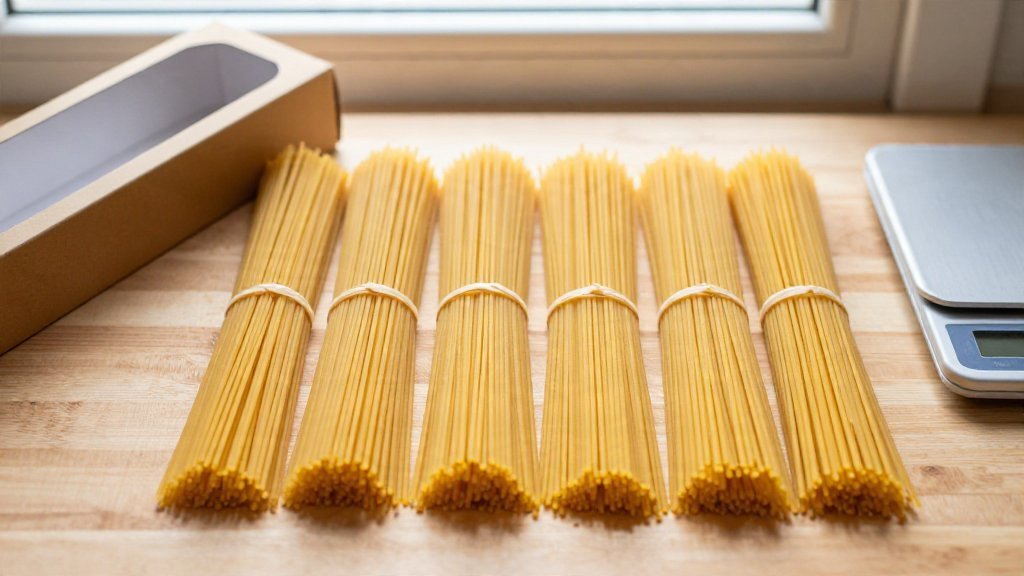
A one-pound box of spaghetti is supposed to feed eight people. That's what the label says, because the official pasta serving size is 2 ounces of dry pasta, about 56 grams, which cooks up to roughly a cup. Ask a chef, though, and you'll hear that two ounces barely counts as dinner.
Both camps are right, and the gap between them is why so many pots of pasta end up too big or too small. Below you'll find how much pasta per person you actually need for a side, a main and a crowd, with the calories for each amount, so you can weigh once and stop guessing.
The pasta serving size on every box is 2 ounces dry
Nutrition labels list a serving of pasta as 2 ounces dry, and a 16-ounce box holds eight of them, as Tasting Table's serving guide lays out. In grams that's 56.7, which most labels round down to 56. You can check the math with our grams to ounces converter.
The FDA sets those label amounts from what people typically eat, not from what anyone recommends, according to a Washington Post report reprinted by The Spokesman-Review. So the 2-ounce figure is a reference point for comparing boxes. It isn't a rule about how hungry you're allowed to be.
Two ounces of dry pasta is 56 grams. It cooks into about one cup of spaghetti, which reads as a side dish to most American eaters and as a normal first course in Italy.
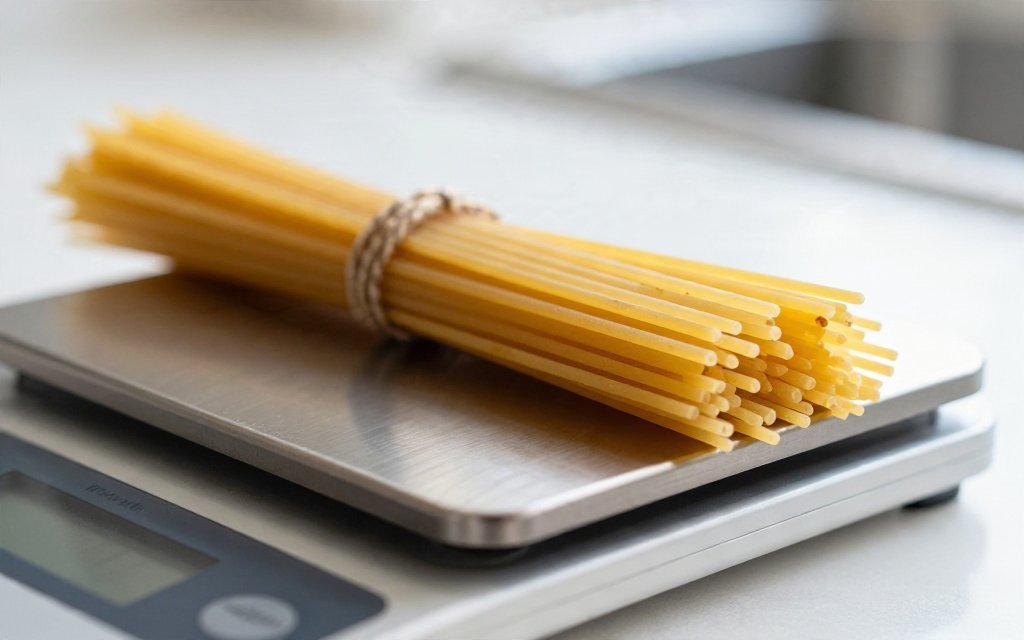
How much pasta per person for a real dinner?
Most Americans eat pasta as the whole meal, not as a course before the meat, and that changes the math. Tasting Table puts a main-course portion at 2 to 3.5 ounces dry per person, and filled shapes like ravioli and tortellini at 4 to 5 ounces.
Chefs quoted in the Post went higher. Matt Adler of Caruso's Grocery uses 4 ounces of dry pasta per restaurant plate, while chef Nini Nguyen says a pound of spaghetti serves six. Chef Adrienne Cheatham was blunt about the label amount: "That's not an entree."
| Meal type | Dry weight | Plates per lb |
|---|---|---|
| Side or first course | 2 oz (56 g) | 8 |
| Light main | 3.5 oz (99 g) | About 4.5 |
| Restaurant main | 4 oz (113 g) | 4 |
| Ravioli or tortellini | 4 to 5 oz (113 to 142 g) | 3 to 4 |
How much spaghetti per person?
For long strands, plan on 3 to 4 ounces dry (85 to 113 grams) when spaghetti is dinner, and 2 ounces when it sits next to a roast. A pound box then covers four or five hungry adults, or eight side portions.
How much macaroni per person?
Macaroni usually swims in cheese, which fills you up faster. Cheatham told the Post that half a cup to a cup of mac and cheese is plenty because it's so rich, so the 2-ounce dry serving holds up here even as a main.
Filled pasta needs more weight
Ravioli and tortellini carry cheese or meat inside, so part of each piece's weight isn't pasta at all. That's why the guideline jumps to 4 to 5 ounces, roughly 113 to 142 grams, per plate.
Pasta portion size by shape, when all you've got is a cup
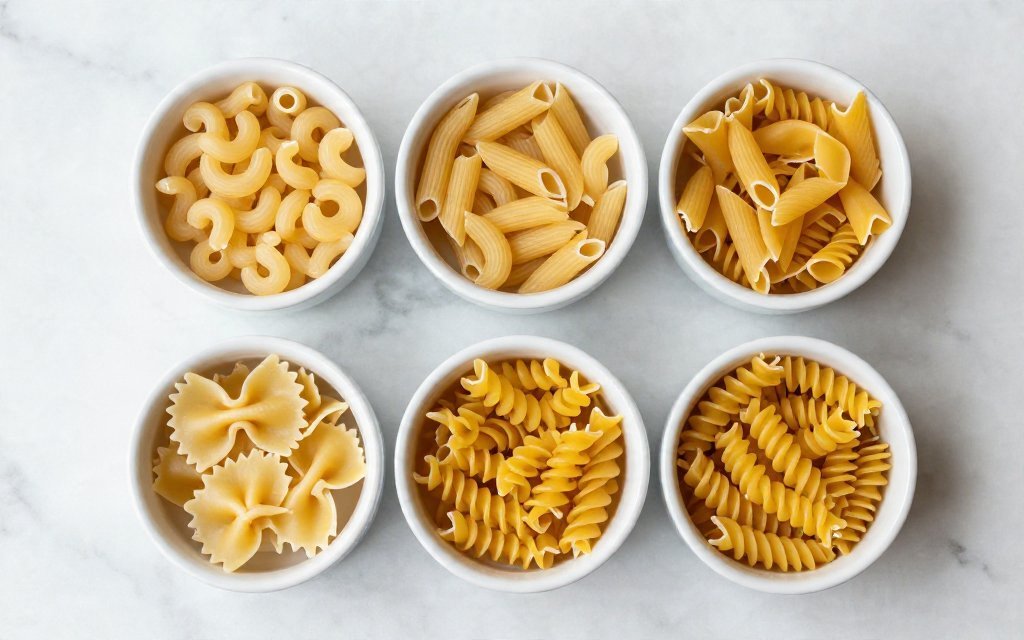
Volume is where pasta measuring goes sideways. USDA data lists one cup of dry elbow macaroni at 122 grams, so a 2-ounce portion of elbows is a bit under half a cup. Long shapes don't fit in a cup at all, and bulky shapes like bow ties leave more air in the cup.
That's the strongest case for a scale. A gram is a gram whether it's penne, rotini or fettuccine, while a cup changes with every shape. If you don't own one, our list of everyday things that weigh 100 grams gives you a rough reference, and a quick scale calibration keeps the one you have honest.
Pasta calories and nutrition facts by the gram
Dry enriched pasta has 371 calories per 100 grams, with 13 grams of protein, 74.7 grams of carbohydrate and 3.2 grams of fiber, according to USDA nutrition data. Scale that to the 56-gram label serving and you get about 208 calories and 7.3 grams of protein.
Cooked numbers look smaller because water adds weight without adding calories. USDA lists cooked enriched spaghetti at 158 calories per 100 grams, and one cup weighs 140 grams for 221 calories. If you've ever typed spaghetti how many calories into a search bar and gotten three different answers, that's why: some sites quote dry weight and some quote cooked.
| Amount | Calories | Protein |
|---|---|---|
| 56 g dry (2 oz) | 208 | 7.3 g |
| 100 g dry | 371 | 13.0 g |
| 113 g dry (4 oz) | 419 | 14.7 g |
| 1 cup cooked (140 g) | 221 | 8 g |
Why cooked pasta weighs more than twice as much
Those 208 calories in 56 grams of dry pasta, spread at 158 calories per 100 grams cooked, come out to roughly 132 grams of cooked noodles. So pasta a bit more than doubles its weight in the pot, and the exact figure shifts with how long you boil it.
Weigh pasta dry whenever you can. 100 grams of dry pasta is always about 371 calories, but 100 grams of cooked pasta depends on how long it boiled and how much water it soaked up.
What a bigger serving of pasta does to your box and your plate
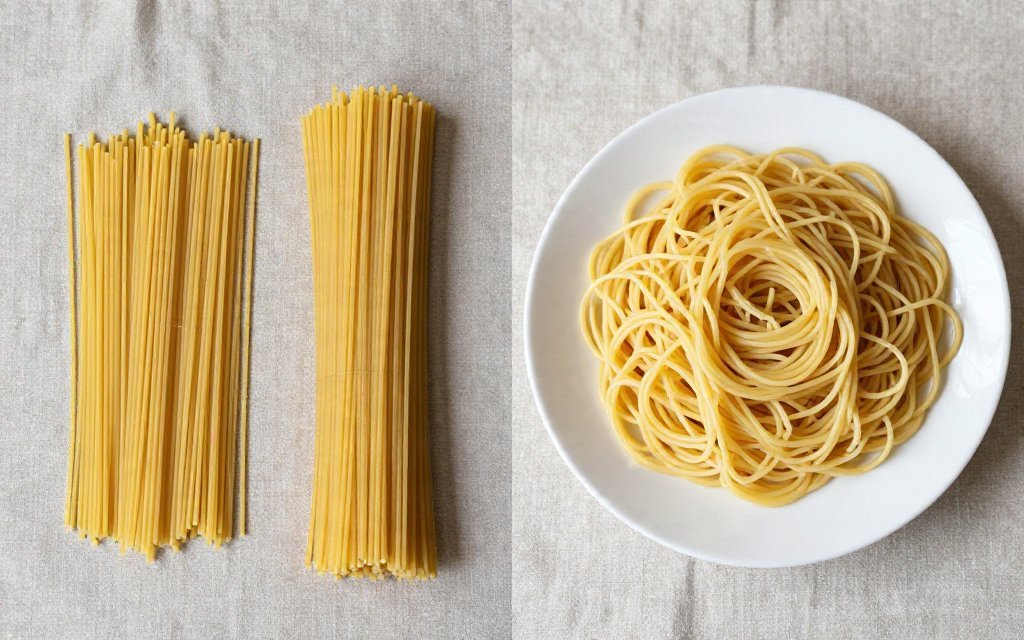
Portion choices compound fast. At the label's 2 ounces, a pound box makes eight servings; at Adler's 4 ounces it makes four, so the same box covers half as many dinners and each plate carries about 419 calories instead of 208.
Across a year it adds up. The National Pasta Association counts 5.95 billion pounds of pasta eaten in the US annually, about 20 pounds a person, according to the Post. At 2 ounces a serving, 20 pounds is 160 meals; at 4 ounces it's only 80, which means twice the grocery spend on pasta for the same number of dinners.
Doubling your pasta portion size from 2 to 4 ounces halves the number of dinners a box makes and adds roughly 210 calories to every plate.
How much pasta per person when you're feeding a crowd
For a group, multiply the headcount by your per-person weight. Tasting Table's example is 12 guests at 2 ounces each, which is 24 ounces, or a box and a half. If pasta is the main event, use 3 to 4 ounces and plan on 36 to 48 ounces for the same 12 people.
Need it in metric? 24 ounces is 680 grams, and 48 ounces is about 1.36 kilograms. Our pounds to grams chart covers the rest.
Pasta questions people ask most
How much pasta for one person?
For one person, weigh 56 grams for a side or 85 to 113 grams for a full dinner. That's 2 ounces, or 3 to 4 ounces, dry. Cooking for one is where a scale helps most, since a small pile of penne is hard to judge by eye.
How many grams of pasta per person?
Label math says 56 grams of dry pasta per person. Chefs who serve pasta as the main course usually land between 85 and 113 grams, and filled pasta runs 113 to 142 grams.
Is the pasta serving size dry or cooked?
Dry. The 2-ounce serving on the box is measured before cooking, and it turns into about a cup of cooked spaghetti. If a recipe means cooked weight, it'll usually say so.
Do pasta nutrition facts change after cooking?
Calories don't vanish in the pot, they just spread over more weight. The 208 calories in 56 grams of dry pasta are still there after boiling, now packed into roughly 132 grams of cooked noodles.
Need to portion pasta without digging out a scale? Download Scale for Grams, snap a photo of your dry pasta, and get an AI-powered weight estimate in grams or ounces in seconds. Get the app here: iOS.
Scale for Grams
Need to Weigh Something?
Download Scale for Grams and get an AI weight estimate from a photo in seconds.
